
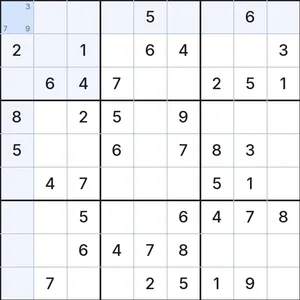
A worked naked triple
Suppose three cells in one row contain candidates {1,4}, {4,9} and {1,9}. Their combined set contains exactly three digits: 1, 4 and 9. Those digits must occupy those three cells in some order, so remove them from other cells in the row. The three cells do not all need to contain all three digits. The same reasoning works in a column or box.
Hidden pairs: look for digits, not matching cells
Suppose 1 and 6 can appear only in columns 2 and 7 of a particular row. Column 2 currently has candidates {1,3,6}, and column 7 has {1,6,8}. Because 1 and 6 need those two positions, remove 3 from column 2 and 8 from column 7. This does not decide the order of 1 and 6; it reduces the other candidates.
X-wing: four corners, one digit
For digit 5, suppose row 3 has candidates only in columns 2 and 8, and row 7 also has candidates only in columns 2 and 8. Each row needs a 5, so the two 5s must use opposite corners of that rectangle. Other cells in columns 2 and 8 cannot contain 5.
| Row | Column 2 | Column 8 |
|---|---|---|
| Row 3 | 5 is possible | 5 is possible |
| Row 7 | 5 is possible | 5 is possible |
| Other rows | Remove candidate 5 | Remove candidate 5 |
Check the word only carefully: if either base row allows 5 in a third column, this particular X-wing is not established. You may transpose the pattern, using two columns and two rows instead.
Swordfish and Y-wing: two further patterns
A swordfish uses three rows whose candidates for one digit are confined to three columns. With a valid three-row pattern, that digit is excluded from other cells in those columns. It is an extension of the same row-and-column restriction used by an X-wing.
For a Y-wing, a pivot with candidates {1,2} sees one cell with {1,7} and another with {2,7}. If the pivot is 1, the first cell must be 7; if it is 2, the second must be 7. An empty cell that sees both of those outer cells cannot contain 7. Merely seeing the pivot is not enough.
Common candidate mistakes
A pencil note is a possibility, not a clue. Keep every legal candidate before looking for patterns, remove candidates ruled out by a new placement, and do not treat two digits in unrelated cells as a pair. Fill notes reconstructs candidates from the current entries and can restore notes you deliberately eliminated, so use Undo if you want your previous manual work back. If you need an explanation on a puzzle of your own, use the logical Sudoku walkthrough.
Choose a hint or reveal a solution
A hint is useful when you want to continue solving for yourself. On a playing grid, request a hint and read the explanation before placing the digit. If you need the completed answer to a separate classic puzzle, use the Sudoku solver with its original clues. For more practice at the same technique, choose medium Sudoku for locked candidates or hard Sudoku for pairs and triples.
Scan before you write
Choose one digit. Look at where it already appears, then inspect the remaining boxes. A row or column containing that digit rules out cells in the same line.
Naked singles
A naked single is a cell with one remaining candidate after its row, column and box are considered. Place that candidate, then update nearby notes.
Hidden singles
A hidden single is a digit with one possible position in a unit. The cell may contain several notes, but the digit has nowhere else to go in that unit.
Locked candidates
If every candidate for a digit inside a box lies in one row, the digit must be in that part of the row, so you can remove it from the rest of the row. The same works the other way round, from a row or column into a box. This is the step that separates medium Sudoku from easy.
Use pairs carefully
If exactly two cells in a unit contain only the same two candidates, those candidates can be removed from the other cells in that unit. Neither cell is solved yet. The same idea with three cells is a triple; both appear in hard Sudoku.
When you get stuck
Check for missing or stale notes before trying a more complex technique. A hint should name the rule it uses. There is no guaranteed one-minute solving method.
How the Hint button helps
The Hint control first checks your entries. If a number does not fit the finished grid, it points to that cell. Otherwise it describes the next logical step, such as a single or a locked candidate, and only places a number after you choose to.
Is there a trick to solve Sudoku in one minute?
No shortcut works on every puzzle. Fast solvers simply recognise singles quickly and keep tidy notes. Practise on easy puzzles, and speed follows from accuracy.
Try a Sudoku deduction
These small examples isolate one rule. They are practice positions, not complete Sudoku puzzles.
Naked single: combine all three checks
Which digit can go in this empty cell when its row, column and box rule out the digits below?
| Unit | Digits it rules out |
|---|---|
| Row | 2, 3, 5 |
| Column | 4, 6, 8 |
| Box | 7, 9 |
Only 1 remains from the digits 1 to 9. The column rules out 4, and the box rules out 7. This is a naked single because the cell has just one candidate.
Hidden single: find the only position
These are the candidates for three cells in a row. None of the other cells in that row can hold 7. Where must 7 go?
| Cell | Candidates |
|---|---|
| Column 1 | 2, 5 |
| Column 2 | 2, 5 |
| Column 3 | 5, 7 |
7 belongs in column 3 because it has no other possible position in the row. The cell still shows another candidate, 5, but the row must contain a 7. That makes this a hidden single.
Naked pair: remove before placing
Two cells in a row each contain only candidates 2 and 8. A third cell in that row has 2, 3 and 8. What remains in the third cell?
| Cell | Candidates before the pair is used |
|---|---|
| Column 1 | 2, 8 |
| Column 4 | 2, 8 |
| Column 6 | 2, 3, 8 |
The first two cells must use 2 and 8 in some order. Neither digit can appear elsewhere in the row, so remove both from column 6. Its only remaining candidate is 3. The pair itself does not tell you which of its two cells holds 2.