
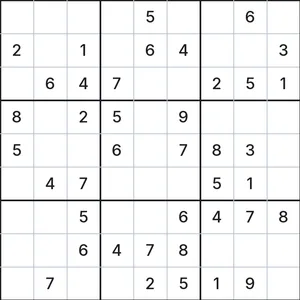
Sudoku rules reference
For another explanation of the classic rules, see the Sudoku rules for complete beginners. Practice here starts with the same row, column and box constraints.
What is Sudoku good for?
Sudoku gives you a structured way to practise deduction: compare constraints, keep track of possibilities and check whether a conclusion follows from the clues. You can enjoy it as a quiet pastime without treating it as a test of speed or a promise of health benefits. Start with an easy Sudoku puzzle and explain the reason for each placement.
Three rules. One grid.
A classic Sudoku has nine rows, nine columns and nine 3 × 3 boxes. Fill every empty cell with a number from 1 to 9. Each number must appear once in every row, column and box.
What is a Sudoku puzzle?
Sudoku is a logic puzzle. The numbers already printed in the grid are called givens. A well-made puzzle has exactly one way to complete the grid, so every placement can be reached by reasoning rather than guessing.
Start with what is missing
Look at a nearly complete row. List its missing numbers. For each empty cell, check the column and box too. If only one number is possible, you have a naked single.
Write notes, then check again
Small pencil numbers are candidates, not answers. Remove candidates that become impossible after a placement. A number must satisfy all three rules at the same time.
No arithmetic required
The digits are symbols for nine different values. You do not add or multiply them in classic Sudoku. Smaller grids use fewer symbols and the same no-repeat idea, which is why Sudoku for kids starts with a 4 × 4 grid.
Words you will meet
A cell is one square. A unit is any row, column or box. A given is a starting number that cannot change. A candidate is a number that could still go in a cell. A single is a cell, or a number, with only one option left.
Your first puzzle
Try Easy Sudoku. Take your time, use Undo if you change your mind, and request a hint when you want a reason for the next move. When singles feel natural, continue with Sudoku tips and hints.